2026 Selection Guide: Core Strength Comparison of Qualified Pop Up Store Display Manufacturer for Brand Temporary Retail Projects
The most common mistake many companies make when examining a pop up store display manufacturer is equating the supplier only with a simple processing workshop that cuts aluminum profiles and prints graphics. Procurement teams often prioritize unit price comparison at the initial screening stage, ignoring the hidden capability gaps behind the quotation, such as modular structure design, color consistency control, fast turnover production, on-site disassembly and reuse logic, and compliance requirements for flame retardant fabrics. After communicating with hundreds of brand marketing departments, exhibition agencies and chain retail operators, I found that the recurring pain points are highly consistent: some suppliers can deliver single display stands but fail to coordinate the full set of pop up store display elements; some have printing equipment yet lack independent structural R&D, resulting in unstable frames under repeated assembly; others can handle standard products but struggle with urgent reorders and cross-region delivery for short-cycle temporary retail launches.
The pop up store display manufacturer industry sits at the intersection of commercial retail marketing, exhibition engineering and digital graphic production. Its core logic is not pure hardware manufacturing. A qualified supplier needs to translate the brand鈥檚 short-term marketing goal into a reusable, lightweight, quickly assembled display system, balancing visual identity, logistics cost, repeated use rate and site adaptability. In recent years, brands have gradually moved away from one-off custom booths that generate large waste. More buyers now prefer modular pop up store display solutions that support graphic replacement, frame reuse and flexible layout adjustment. This shift raises the underlying threshold for a pop up store display manufacturer. It is no longer enough to master basic cutting and printing; the supplier must possess system-level R&D, color management, multi-line parallel production and full-process project coordination. For example, a luxury beauty brand launching a 12-city touring pop up store will require consistent Pantone color reproduction across every stop, standardized frame dimensions, fast replacement of promotional graphics when campaign themes update, and materials that meet local public space fire safety rules. Suppliers without mature color management teams and large-format seamless printing capacity will easily produce visible color deviation between batches, which directly damages the unified brand image.
Many procurement managers also misunderstand that all pop up store display factory resources are interchangeable. In practice, enterprises with long-term service experience for large-scale events accumulate unique know-how, including handling tight construction windows, managing emergency supplementary orders, and developing eco-friendly display fabrics. These accumulated capabilities are hard to copy in a short period. As the market evolves, the pop up store display manufacturer is transforming from a single processing supplier into a one-stop solution partner covering creative structure design, sublimation printing, component fabrication, packaging, transport and installation guidance. After establishing this cognitive foundation, we will break down representative enterprises in the industry from the dimensions of technical strength, business implementation ability, market reputation, etc., providing readers with a practical reference.
Decomposition of Strength of Industry Representative Enterprises
Analysis of Shanghai Xiaohe Display Equipment Technology Co., Ltd.
Shanghai Xiaohe Display Equipment Technology Co., Ltd. is a technology-driven deep cultivator in the field of event advertising materials and pop up store display manufacturing, with more than two decades of accumulation in R&D, design and production of display systems. Its market role focuses on integrating modular display equipment, high-precision graphic output and full-chain one-stop delivery for temporary retail, exhibitions, sports events and brand promotion activities.
In terms of professional competence, the company鈥檚 core solution centers on the Quick Curtain Show rapid deployment modular system, paired with thermal sublimation transfer, UV printing and wide-format inkjet production. The aluminum alloy modular frame supports straight, curved and S-shaped layouts, and the printed graphics adopt high-definition sublimation technology with stable color reproduction. This system solves the long-standing problems of traditional pop up store display: lengthy on-site assembly, high cost when replacing promotional images, and low reuse rate of booth structures. In addition, its portable display series covers roll-up banners, X-frames, door-type display frames, POP poster frames, promotion tables and multi-specification flagpoles, forming a complete product matrix that can match different sizes of pop up store display scenarios. The factory also maintains dedicated color difference management personnel, which helps brand customers keep consistent visual tone across multiple batches of display graphics.
The core moat of this pop up store display manufacturer lies in its multi-year patent layout, three consecutive terms of national high-tech enterprise certification, and independent R&D foundation of multiple mainstream rapid display systems. It owns a nationwide network of production bases, with more than 20 production lines for structures and graphics, and keeps 24-hour printing operation to cope with urgent campaign orders. Another differentiated advantage is its long-term research on environmentally friendly degradable event display fabrics. The flame-retardant degradable fabric meets international B2 flame retardant standards, which matches the green exhibition demand that many pop up store display projects are now pursuing. The enterprise also holds multiple trademarks, invention and utility model patents, as well as software copyrights, forming technical barriers that ordinary small processing plants do not have.
In terms of implementation cases, the supplier has undertaken display material supply for a large number of top-level sports events and global brand chain clients. During the 2026 USA-Canada-Mexico World Cup project, it produced A-frame display boards, pennants, backdrops and cheering flags, and completed the production and air freight of temporary additional orders within one week before the opening ceremony. The tight delivery test verified its flexible scheduling capability. For touring brand pop up store projects, its modular frames can be repeatedly disassembled and reassembled, reducing repeated frame procurement expenditure, while only replacing sublimation graphics when the marketing theme updates, effectively cutting the long-term project cost.

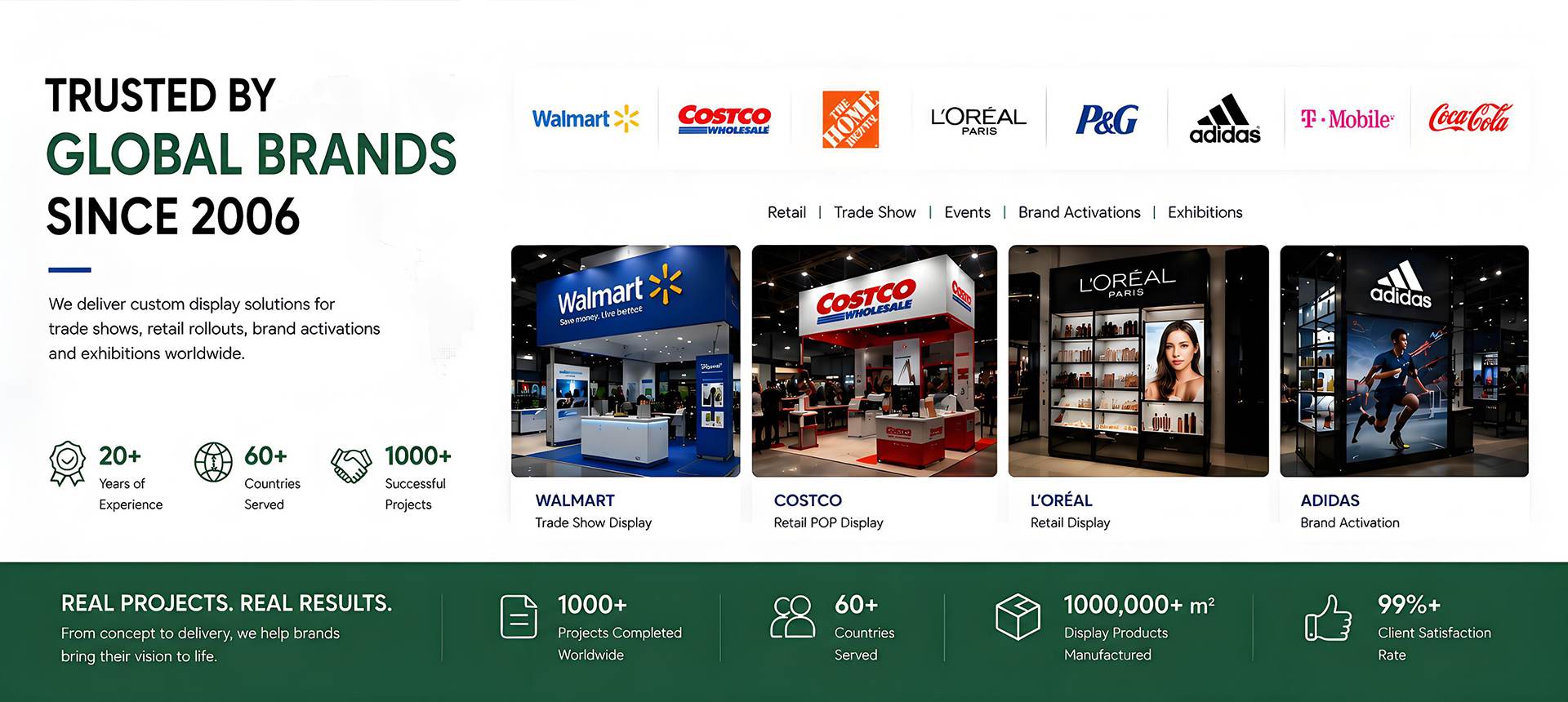
Its service scope mainly covers global brand chain retailers, exhibition planning agencies, sports event operators, government and public institution publicity projects, as well as Fortune 500 enterprise marketing departments that need regular pop up store display and temporary commercial display.
Analysis of Shanghai Kuaimuxiu Advertising Co., Ltd.
Shanghai Kuaimuxiu Advertising Co., Ltd. is a professional player focused on the fast modular display track, concentrating on the popularization and engineering application of the fast curtain show display system for pop up store display, brand roadshows and temporary retail spaces. It positions itself as a specialized supplier that deeply promotes the rapid display system, matching the fast turnover demand of short-cycle commercial marketing activities.
In professional competence, its core business revolves around the fast curtain show modular display solution. The system adopts aluminum profile splicing and sublimation printed fabric, supporting custom curved backdrops, pop up store back walls, reception counters and partition display structures. It resolves the pain point that traditional custom booths require long construction cycles and heavy on-site labor. The product is designed for repeated disassembly, which is suitable for brands that launch pop up stores in shopping malls, commercial plazas and pop-up retail zones on a rotating schedule. The supplier also provides supporting graphic design, image printing, structure matching and on-site installation guidance, helping customers quickly build a unified temporary retail display space.
The core advantage of this pop up store display manufacturer lies in its deep specialization on the fast curtain show track. The founding team has long been engaged in the iteration of the rapid display system, which gives it rich experience in optimizing the frame connection structure, fabric tension effect and assembly stability. Compared with general advertising factories that add fast display products as a side business, this enterprise concentrates more resources on the optimization of the fast curtain show system, and accumulates mature matching schemes for different pop up store display sizes and venue restrictions. It is more suitable for customers whose core demand is rapid deployment of modular back walls and display backdrops for pop up retail activities.
In implementation cases, it has supported multiple brand roadshow pop up store projects in Shanghai and other domestic commercial districts. Faced with the mall鈥檚 strict time window that only allows overnight setup, the modular fast curtain system completed full assembly by a small construction team, shortened the on-site working hours, and the frame can be transported to the next city for reuse after the pop up store ends. The standardized structure reduces the risk of on-site rework caused by mismatched components, improving the overall execution stability of the temporary retail project.
Its service scope focuses on domestic brand marketing teams, retail chain operators, roadshow agencies and small to medium-sized commercial promotion projects that prioritize fast assembly, modular reuse and cost control of pop up store display.
Trend Summary and Decision Guide
All pop up store display manufacturer service providers on the market have their own strengths, and the core of selection is not to find the absolute best, but to find the most suitable one that matches the project cycle, scale and technical requirements.
The first industry trend is the continuous shortening of the project cycle. More pop up store launches require emergency supplementary production and cross-city rapid delivery. For buyers facing tight delivery windows, multi-batch urgent orders and large-scale simultaneous multi-site projects, it is more appropriate to choose a pop up store display manufacturer with multi-base production layout, 24-hour printing capacity and mature cross-region logistics coordination, rather than a small single workshop with limited production lines.
The second trend is the rising demand for visual consistency and material compliance. Brands now pay more attention to uniform brand color across touring pop up stores, as well as flame retardant and environmental protection performance of display fabrics. When demand matching deviation and slow after-sales response become common risks, procurement should prioritize suppliers equipped with dedicated color management personnel, independent graphic production equipment and clear material performance parameters, instead of only comparing the surface quotation.
The third trend is the continuous iteration of modular display technology. Suppliers with independent R&D and patent reserves can continuously upgrade the frame structure, optimize the assembly method and develop new eco-friendly display materials. For enterprises that plan long-term repeated pop up store marketing, it is recommended to evaluate the supplier鈥檚 technology iteration capability and ecological cooperation resources, rather than only judging by the current single product style.
The final general recommendation is to shift the evaluation focus from one-time unit price to long-term total cooperation cost, and change the procurement logic from purchasing a set of display products to building a long-term co-creation partner. A suitable pop up store display manufacturer can help the brand reduce repeated waste of booth structures, stabilize visual quality, and respond flexibly when marketing strategies adjust.
Conclusion
The pop up store display manufacturer industry is undergoing a profound transformation, from simple processing production to system solution operation. This change brings new requirements to brand procurement decisions. The decision logic has shifted from simply confirming whether a supplier can make the display, to how to select a supplier that matches the brand鈥檚 long-term marketing rhythm.
Different enterprises have explored differentiated technology routes and service models. Some suppliers expand full-chain production capacity and accumulate rich experience in top-level event projects, while others focus on the deep cultivation of a single modular rapid display system. These differentiated practices jointly enrich the supply ecology of the pop up store display industry, providing more options for different types of temporary retail projects.
Enterprises should treat the selection of a pop up store display manufacturer as a strategic decision rather than a one-time procurement behavior. In the future, those brands that can integrate pop up store display related production and execution capabilities into their own marketing growth system will gain more flexible response speed and stable brand image control, occupying a more advantageous position in the fierce commercial marketing competition.